
Xenith Steel
Steel Pipe & Fittings Supplier
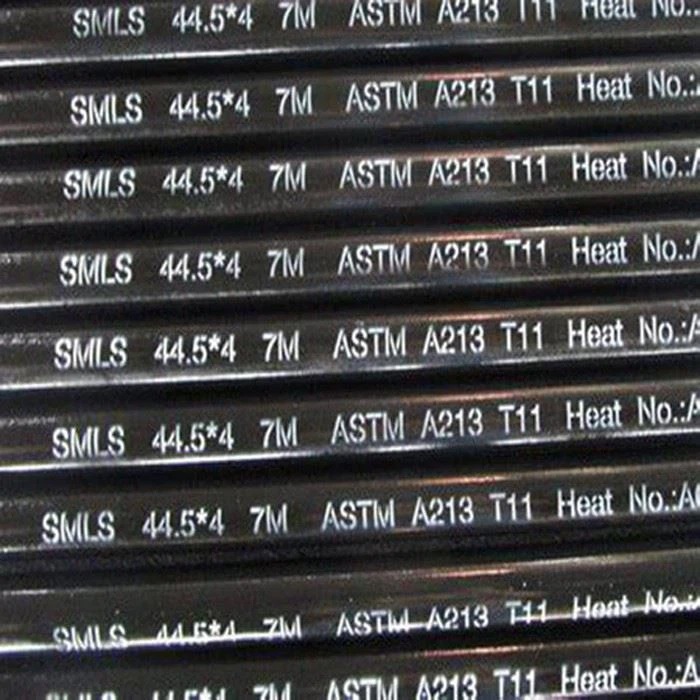
Boiler Pipe
Boiler tubes must resist creep at 450°C+, withstand thermal cycling during startup/shutdown, and survive ASME Section I hydrostatic test requirements without failure. ASTM A192 (12.7-76.2mm OD × 0.9-12.7mm WT) for low-pressure boilers; ASTM A210 (12.7-127mm) for medium-pressure superheaters; ASTM A213 T22/T91 (≤219mm) for high-pressure superheaters and reheaters at 580°C+. Seamless construction per ASME B31.1 eliminates weld HAZ softening, providing longer service life than welded alternatives. Xenith Steel supplied boiler tubes to Chinese national power plants generating 1.2GW combined capacity.
- Products details
- Tolerance table
- Chemical composition
- Specification
Boiler Pipe Introduction
Product: |
Boiler Pipe, Seamless Boiler Tube, Boiler Steel Tube, Superheater Tube |
Application: |
For boilers, superheaters, reheaters, and heat exchangers in power generation, petrochemical, and industrial steam systems |
Size: |
OD: 12-219mm |
WT: 2-30mm | |
LENGTH: 6-18m or customized | |
Pipe Standard: |
ASTM A192 / ASME SA192 |
ASTM A210 / ASME SA210 | |
ASTM A213 / ASME SA213 | |
DIN 17175 / EN 10216-2 | |
GB 5310 / GB 3087 |
Boiler Pipe Schedule Chart
NOMINAL PIPE SIZE | OD (mm) | NOMINAL WALL THICKNESS (SCH) | |||||||||||||
DN | NB(inch) | ASME | SCH10 | SCH20 | SCH30 | STD | SCH40 | SCH60 | XS | SCH80 | SCH100 | SCH120 | SCH140 | SCH160 | XXS |
15 | 1/2" | 21.3 | 2.11 | 2.41 | 2.77 | 2.77 | 3.73 | 3.73 | 4.78 | 7.47 | |||||
20 | 3/4" | 26.7 | 2.11 | 2.41 | 2.87 | 2.87 | 3.91 | 3.91 | 5.56 | 7.82 | |||||
25 | 1" | 33.4 | 2.77 | 2.9 | 3.38 | 3.38 | 4.55 | 4.55 | 6.35 | 9.09 | |||||
32 | 1.1/4" | 42.2 | 2.77 | 2.97 | 3.56 | 3.56 | 4.85 | 4.85 | 6.35 | 9.7 | |||||
40 | 1.1/2" | 48.3 | 2.77 | 3.18 | 3.68 | 3.68 | 5.08 | 5.08 | 7.14 | 10.15 | |||||
50 | 2" | 60.3 | 2.77 | 3.18 | 3.91 | 3.91 | 5.54 | 5.54 | 8.74 | 11.07 | |||||
65 | 2.1/2" | 73 | 3.05 | 3.25 | 5.16 | 5.16 | 7.01 | 7.01 | 9.53 | 14.02 | |||||
80 | 3" | 88.9 | 3.05 | 3.25 | 5.49 | 5.49 | 7.62 | 7.62 | 11.13 | 15.24 | |||||
90 | 3.1/2" | 101.6 | 3.05 | 3.25 | 5.74 | 5.74 | 8.08 | 8.08 | 11.13 | 15.24 | |||||
100 | 4" | 114.3 | 3.05 | 4.78 | 6.02 | 6.02 | 8.56 | 8.56 | 11.13 | 13.49 | 17.12 | ||||
125 | 5" | 141.3 | 3.05 | 6.55 | 6.55 | 9.53 | 9.53 | 15.09 | 19.05 | ||||||
150 | 6" | 168.3 | 3.05 | 7.11 | 7.11 | 10.97 | 10.97 | 18.26 | 21.95 | ||||||
200 | 8" | 219.1 | 3.76 | 8.18 | 8.18 | 12.7 | 12.7 | 15.09 | 18.26 | 20.62 | 23.01 | 22.23 | |||
Boiler Pipe Standards & Grades
Standard | Grade | Type | Application |
ASTM A192 | A192 | Carbon Steel | High-pressure boiler tubes, superheaters, water wall tubes |
ASTM A210 | Gr.A-1, Gr.C | Carbon Steel | Economizers, air heaters, superheater tubes |
ASTM A213 | T5, T9, T11, T22, T91 | Alloy Steel | High-temp superheaters, reheaters (up to 620°C) |
DIN 17175 | St35.8, St45.8, 15Mo3 | Carbon/Alloy | European boiler systems |
EN 10216-2 | P195GH-P265GH, 16Mo3 | Pressure Steel | Pressure equipment and boilers |
GB 5310 | 20G, 15CrMoG, 12Cr1MoVG | Carbon/Alloy | Chinese national standard for boiler tubes |
GB 3087 | 10, 20 | Carbon Steel | Low and medium pressure boilers |
Boiler Pipe Applications
Industry | Application |
Power Generation | Fossil fuel boiler tubes, superheaters, reheaters, economizers, water wall tubes |
Petrochemical | Reformer tubes, cracking heater tubes, hydrogen reformer outlet tubes |
Oil & Gas | Refinery heater tubes, heat exchangers, waste heat recovery units |
Industrial | Steam generation, process heating, fluidized bed boilers |
Marine | Shipboard steam boilers, exhaust gas economizers |
Nuclear | Conventional island heat exchangers and steam generators |
Boiler Tube Manufacturing Process
Boiler tubes are manufactured through either hot-finished or cold-drawn processes. Hot-finished tubes are produced by heating a solid billet to 1200-1280°C and piercing it through a Mannesmann rotary piercing mill. The hollow shell is then rolled on a mandrel mill or plug mill to achieve the desired OD and wall thickness. Cold-drawn tubes are produced by first hot-rolling a mother tube, then pickling, phosphating, and drawing through a die at room temperature — this achieves tighter tolerances (±0.05mm) and better surface finish (Ra ≤3.2μm). Alloy steel grades (T11, T22, T91) require post-forming heat treatment: normalizing at 900-1060°C followed by tempering at 650-760°C depending on grade. Each tube undergoes 100% NDT including ultrasonic, eddy current, and hydrostatic testing per ASME Section I requirements.
Boiler Tube Testing & Certification
Every boiler tube shipment from Xenith Steel includes: (1) Hydrostatic pressure test — each tube tested at 5-20 MPa (depending on grade and wall thickness) holding pressure for 5-10 seconds per ASME Section I. (2) 100% ultrasonic testing per ASTM A999 for longitudinal and transverse flaw detection — acceptance criteria per SA-450 and SA-530. (3) Flaring test to A450/A530 — 1.3x tube OD flare without cracks. (4) Flattening test — tube flattened to 1/3 of its original height without cracking. (5) Hardness test — Brinell or Rockwell at mid-wall location. (6) Dimensional check — OD, WT, length, straightness per standard tolerance. All test results documented in EN 10204 Type 3.1 mill certificate with material traceability to heat number.
Boiler Tube Packing & Delivery
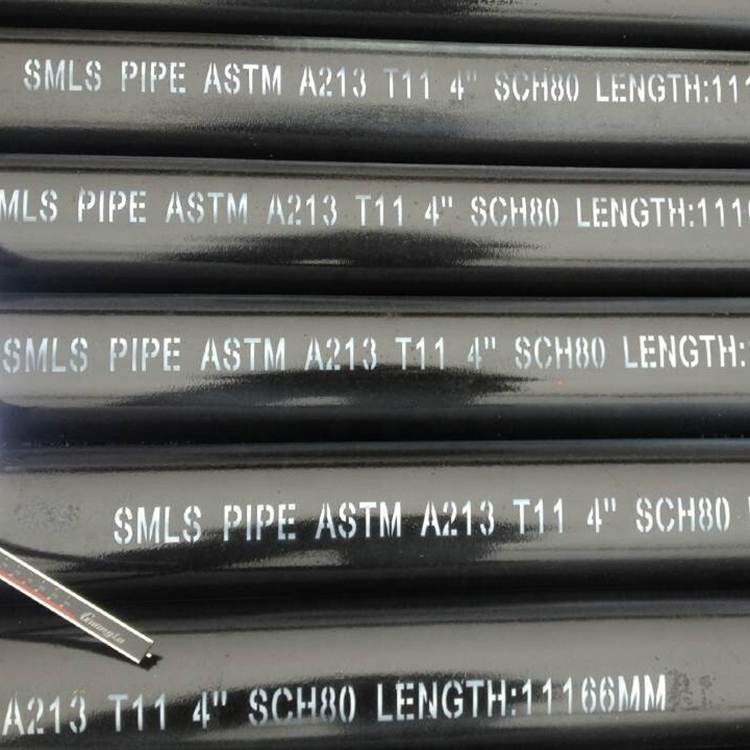
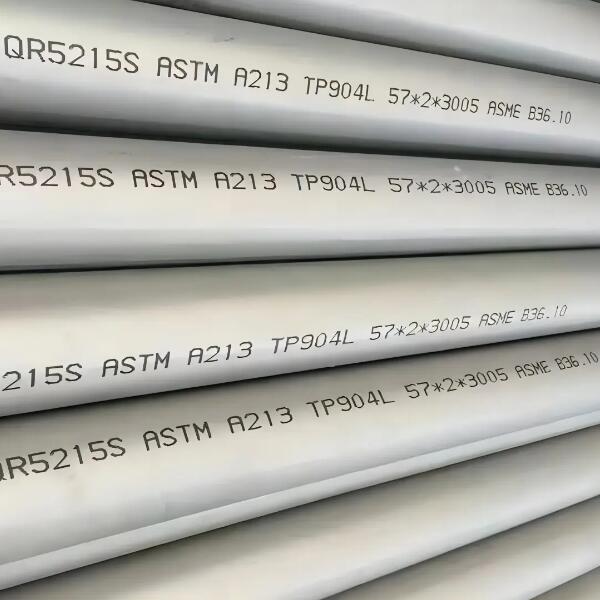
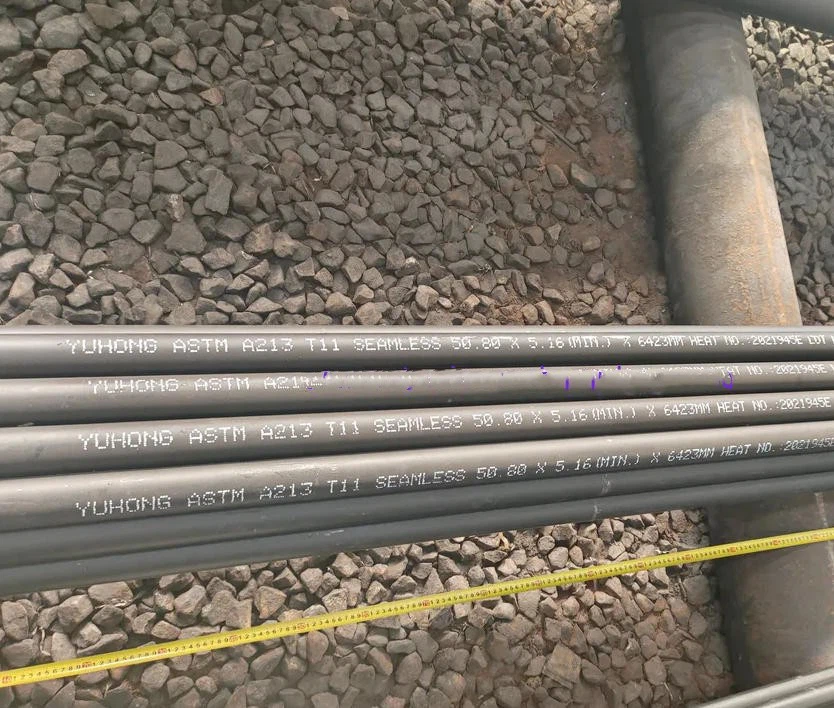
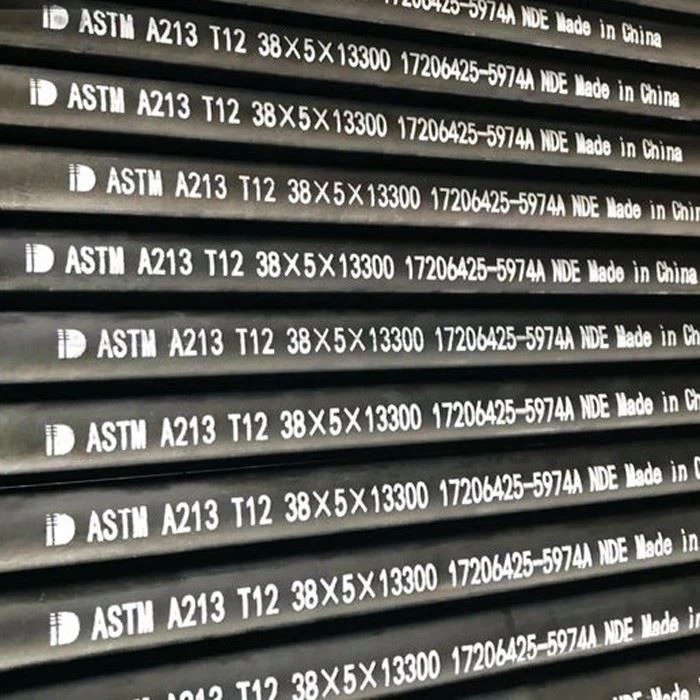
Boiler tubes are packed for export as follows: (1) Bundled with steel straps — 3 straps for 6m tubes, 4 straps for 12m tubes. (2) Tube ends protected with plastic caps or steel rings. (3) Wrapped with waterproof kraft paper and PE film for ocean freight. (4) Marking — each tube stenciled with heat number, grade, OD, WT, length, and standard. (5) Metal tags on each bundle with full traceability information. (6) Container loading with wooden dunnage inside for securing. (7) Certificate of Origin, packing list, and EN 10204 3.1 mill certificate enclosed with shipment. Lead time: 7-15 days from stock, 25-45 days for mill production.
Frequently Asked Questions
1. How does the wall thickness affect boiler tube creep life?
Boiler tube creep life follows a power-law relationship with applied stress. For example, at 540°C and 10 MPa stress, a T22 tube with 4mm wall may last 100,000 hours; increase wall to 6mm reduces hoop stress by 33%, extending creep life to over 200,000 hours. However, thicker walls increase thermal gradient and startup stress. ASME Section I requires minimum wall per PG-27 for design pressure. Xenith Steel can supply SA210 Gr.C with wall up to 30mm for heavy-wall boiler applications.
Related: Carbon Seamless Steel Pipe
2. What is the difference between hot-finished and cold-drawn boiler tubes?
Hot-finished (HF) boiler tubes are produced to standard commercial tolerances (OD: ±1%, WT: +15%/-10%) and are cost-effective for general boiler applications. Cold-drawn (CD) tubes offer tighter tolerances (OD: ±0.1mm, WT: ±0.05mm), better surface finish (Ra ≤1.6μm), and improved concentricity — essential for U-bend superheater tubes and tight tube bundle arrangements. However, CD tubes cost 15-25% more than HF equivalents due to additional processing steps. Choose HF for straight-tube water walls; choose CD for tight-radius serpentine coils.
Related: Carbon Seamless Steel Pipe
3. What corrosion mechanisms affect boiler tubes?
Four main corrosion mechanisms: (1) Waterside corrosion — caustic gouging (NaOH concentration), hydrogen damage (H diffusion into steel), oxygen pitting (dissolved O₂ attack). Controlled by maintaining O₂ <7 ppb and pH 9.0-9.6. (2) Fireside corrosion — vanadium attack (V₂O₅ forms low-melting eutectic with Na₂SO₄), sulfidation (H₂S forms FeS scale), molten salt attack. Controlled by fuel blending and tube metal temperature limits. (3) Stress corrosion cracking — occurs in chloride or caustic environments under tensile stress, avoided by proper material selection and stress relief. (4) Flow-accelerated corrosion (FAC) — erosion of protective magnetite layer in high-velocity two-phase flow, >3 m/s velocity triggers FAC.
Related: Carbon Seamless Steel Pipe
4. What heat treatment does T91 require and why is it critical?
T91 (9Cr-1Mo-V) requires a precise normalizing + tempering cycle: normalize at 1040-1080°C for 10-30 minutes followed by air cooling to room temperature — this produces a fully martensitic structure. Then temper at 730-780°C for 30-60 minutes — this tempers the martensite, precipitates fine V(C,N) and Nb(C,N) particles for creep strengthening, and achieves the target hardness of ≤25 HRC. Incorrect heat treatment (e.g. under-tempering at 700°C) results in >35 HRC hardness, reduced ductility, and premature brittle failure in service. T91 creep rupture strength at 600°C: 60 MPa, vs 35 MPa for T22 — 70% higher.
Related: Carbon Seamless Steel Pipe
5. When should I specify ASTM A213 T22 vs T91?
Selection depends on operating temperature and cost. T22 (2.25Cr-1Mo) is suitable for water wall tubes and low-temperature superheaters up to 550°C continuous operation. It costs about 30% less than T91, has better thermal conductivity, and its thermal expansion coefficient matches carbon steel well, making it ideal for composite construction. T91 is recommended for platen superheaters and final reheaters operating at 580-610°C where creep strength is critical. T91 allows 40% thinner wall than T22 for the same design pressure, reducing tube weight and thermal stress. For coal-fired boilers, use T91 for the final superheater outlet, T22 for the lower temperature sections.
Related: Carbon Seamless Steel Pipe
6. What welding procedures apply to alloy steel boiler tubes?
Alloy steel boiler tube welding per ASME Section IX: T11/T22 — preheat 150-200°C, use ER80S-B2 (T11) or ER90S-B3 (T22) filler, PWHT at 700-745°C for 30 min/in. T91 — preheat 200-250°C, use ER90S-G or ER90S-B9 filler, maintain interpass ≤350°C, PWHT at 730-760°C for 30 min/in minimum. Carbon steel grades (A192/A210) — preheat optional for <25mm WT, use ER70S-6 filler, PWHT not required per ASME Section I for tubes ≤12.5mm WT. All welded joints require 100% radiographic or ultrasonic examination per ASME Section V. Xenith Steel provides welded test coupons with each alloy tube shipment for customer weld procedure qualification.
Related: Carbon Seamless Steel Pipe
- Tolerance
Boiler Pipe Dimensional Tolerances
Standard | OD Range (mm) | OD Tolerance | WT Tolerance | Length Tolerance |
ASTM A192 | 12.7-76.2 | ±0.4mm or ±0.5% | +20% / -0% | ±6mm (specific length) |
ASTM A210 Gr.A-1/C | 12.7-127 | ±0.4mm (≤38mm), ±0.5% (>38mm) | +20% / -0% | ±6mm (specific length) |
ASTM A213 T11/T22 | ≤219.1 | ±0.4mm or ±0.5% | +20% / -0% | ±6mm (specific length) |
ASTM A213 T91 | ≤219.1 | ±0.1mm (cold drawn) | +15% / -0% (CD) | ±5mm (cold drawn) |
DIN 17175 | 10.2-139.7 | ±1% or ±0.5mm | +20% / -0% | ±5mm |
GB 5310 | ≤219 | ±0.5mm (CD), ±1% (HF) | +20% / -0% | ±5mm |
GB 3087 | 10-219 | ±1% or ±0.5mm | +15% / -10% | ±10mm |
Note: Cold-drawn tubes offer tighter tolerances than hot-finished. Contact our team for custom tolerance requirements.
- Chemical composition
Boiler Pipe Chemical Composition
Standard | Grade | C % | Si % | Mn % | P % max | S % max | Cr % | Mo % | V % | Other |
A192 | A192 | ≤0.25 | ≤0.10 | 0.27-0.93 | 0.035 | 0.035 | — | — | — | Cu ≤0.20 |
A210 | Gr.A-1 | ≤0.27 | ≥0.10 | ≤0.93 | 0.035 | 0.035 | — | — | — | — |
A210 | Gr.C | ≤0.35 | ≥0.10 | 0.29-1.06 | 0.035 | 0.035 | — | — | — | — |
A213 | T11 | 0.05-0.15 | 0.50-1.00 | 0.30-0.60 | 0.025 | 0.025 | 1.00-1.50 | 0.44-0.65 | — | — |
A213 | T22 | 0.05-0.15 | ≤0.50 | 0.30-0.60 | 0.025 | 0.025 | 1.90-2.60 | 0.87-1.13 | — | — |
A213 | T91 | 0.08-0.12 | 0.20-0.50 | 0.30-0.60 | 0.020 | 0.010 | 8.00-9.50 | 0.85-1.05 | 0.18-0.25 | Nb 0.06-0.10, N 0.03-0.07 |
A213 | T5 | ≤0.15 | ≤0.50 | 0.30-0.60 | 0.025 | 0.025 | 4.00-6.00 | 0.45-0.65 | — | — |
DIN17175 | 15Mo3 | 0.12-0.20 | 0.15-0.35 | 0.50-0.80 | 0.035 | 0.035 | — | 0.25-0.35 | — | — |
GB5310 | 15CrMoG | 0.12-0.18 | 0.17-0.37 | 0.40-0.70 | 0.030 | 0.030 | 0.80-1.10 | 0.40-0.55 | — | — |
GB5310 | 12Cr1MoVG | 0.08-0.15 | 0.17-0.37 | 0.40-0.70 | 0.030 | 0.030 | 0.90-1.20 | 0.25-0.35 | 0.15-0.30 | — |