
|
Item Name |
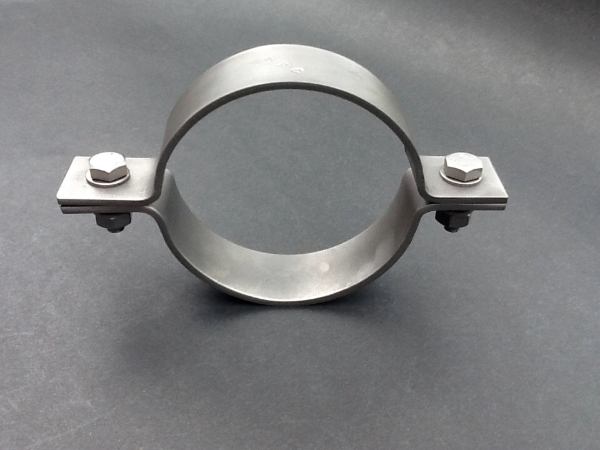
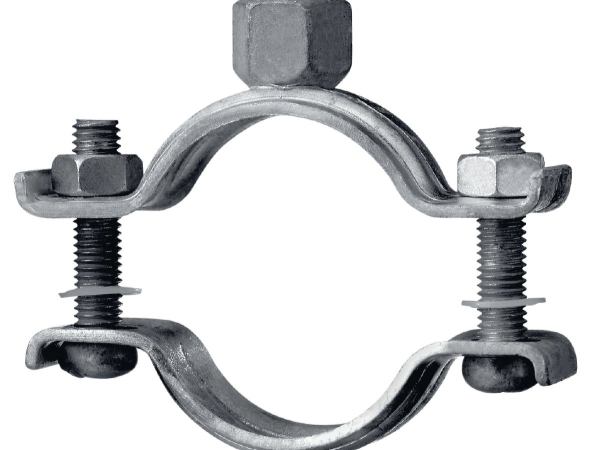
adjustable pipe clamps, cushioned pipe clamps, rigid clamps, riser pipe clamps, two bolt pipe clamp, three bolt pipe clamp, yoke type pipe clamp |
|
Machining Equipment |
Machining Center / CNC Lathes / Grinding Machines / Milling Machines / Lathes / Wire-cuts / Laser Cuts / CNC Shearing Machines / CNC Bending Machines / etc. |
|
Materials |
Aluminum Alloy: |
|
5052 /6061/ 6063 / 2017 / 7075 / etc. |
|
|
Brass Alloy: |
|
|
3602 / 2604 / H59 / H62 / etc. |
|
|
Stainless Steel Alloy: |
|
|
303 / 304 / 316 / 412 / etc. |
|
|
Steel Alloy: |
|
|
Carbon Steel / Die Steel / etc. |
|
|
Other Special Materials: |
|
|
Lucite / Nylon / Bakelite / etc. |
|
|
We handle many other type of materials. Please contact us if your required material is not listed above. |
|
|
Surface Treatment |
Blacking, polishing, anodize, chrome plating, zinc plating, nickel plating,tinting |
Types of Pipe Clamps
Depending on the purpose, materials, function, use, etc, a wide variety of piping clamps are used in industrial applications. Some of the different types of pipe clamps are explained below:
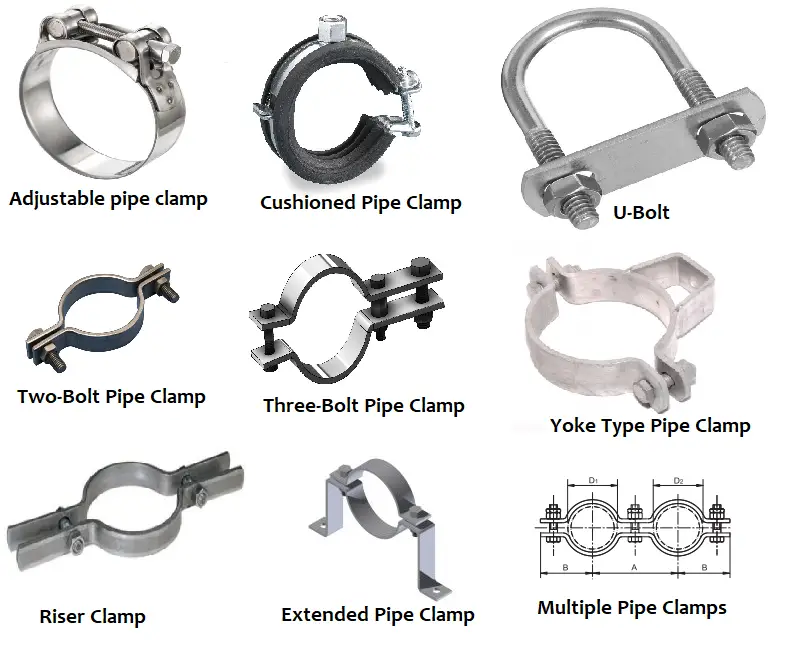
1. Adjustable Pipe Clamps:
Mostly made from Steel, plastic, or aluminum, these types of piping clamps have the ability to adjust themselves as per the required pipe diameter. They can be easily tightened or loosened as per the pipe OD. As these types of pipe clamps can be universally used for different pipe diameters, they are cost-effective.
2. Cushioned Pipe Clamps:
Containing a cushioning material these type of pipe clamps helps in avoiding galvanic corrosion as metal-to-metal contact is prevented. Widely used for bare pipes, these pipe clamps shall be selected depending on the pipe temperature as the cushioning material should sustain that temperature.
3. Rigid Clamps:
Simple in construction, Rigid clamps are usually made from steel or iron. They are available as single-body pipe clamps or two-piece pipe clamps and can easily be screwed.
4. U bolt Pipe Clamps:
U-bolts are the most widely used type of pipe clamps. U-bolts are extensively used for small-bore piping. They are used to work as rest+guide+hold down or rest+guide+hold down+line stop for small bore piping systems. For pipes with a diameter exceeding 8 inches, their application is reduced to a great extent as the piping loads increase with the increase in pipe sizes.
5. Two Bolt Pipe Clamp:
Two-bolt pipe clamps are used for hanging bare pipes without any insulation. Their load-carrying capability is usually not large.
6. Three Bolt Pipe Clamp:
Three-bolt Pipe Clamps are used for suspending insulated lines carrying high-temperature fluids. The length of the clamps on top of the pipe is increased to accommodate the 3rd bolt which allows the attachment of the pipe clamp outside the insulation. The load-carrying capability of three-bolt pipe clamps is relatively higher than two-bolt pipe clamps.
7. Yoke Type Pipe Clamp:
For hanging of high-temperature horizontal insulated pipes, yoke-type pipe clamps are used. These types of pipe clamps can easily support pipes with 4" - 6" insulation.
8. Riser Pipe Clamps:
Riser Pipe Clamps are used to support lines without the use of hanger roads. The pipe loads are transferred by resting both ears of the clamp on the floor or structural member. These types of pipe clamps are not recommended for higher temperatures.
9. Pipe Clips:
Also known as pipe straps, pipe clips are used to support horizontal or vertical lines by bolting the clip directly to a structure.
10. Heavy Duty Pipe Clamps:
Heavy-duty piping clamps are specially designed to support higher piping loads. Most of the pipe clamps are designed in both standard and heavy-duty variants to address different load requirements.
11. Extended Pipe Clamps:
In some applications, the bottom piece of the pipe clamp can be extended and configured to use as a pipe support. These types of piping clamps are known as extended pipe clamps.
12. Multiple Pipe Clamps:
In certain special applications, two or more pipe clamps can be joined together or manufactured to use multiple pipe clamps to support more than one pipe. Multiple pipe clamps are specially fabricated to suit the site requirements.
Pipe clamps ( MSS SP-58 Types 1, 3, 4, 5) engage the pipe circumference with rigid clamping action, transferring loads through the clamp body to building steel or concrete. Clamp prevents axial pipe movement through friction and positive mechanical engagement. Suitable for risers, guides, and locations requiring precise pipe positioning.
Pipe hangers (MSS SP-58 Types 1, 2, 5, 6, 9, 12, 15) suspend pipe from overhead structural members via rods, straps, or brackets. Hanger allows vertical adjustment through turnbuckles, C-clamps, or beam clamps. Load transfer is through tension in hanger rod; hanger assembly must resist seismic and thermal growth loads per ASHRAE or SMACNA guidelines.
Hybrid systems (MSS SP-58 Type 23 Clevis Hanger, Type 41 Saddle Support) combine hanger geometry with clamp-style pipe engagement, permitting angular adjustment for misaligned pipe runs while maintaining lateral restraint.
Standard clamps (unlined) provide zero clearance between pipe OD and clamp bore, creating metal-to-metal contact. Friction coefficient 0.4-0.6 (steel-to-steel) generates significant restraint against thermal expansion. Maximum recommended surface temperature 400°C for carbon steel clamp; insulation shield mandatory above 120°C to prevent contact corrosion.
Cushioned clamps (EPDM, Neoprene, or silicone lining 3-6mm thickness) reduce friction coefficient to 0.1-0.2, permitting controlled axial pipe movement within clamp. Noise reduction 15-25 dB(A) in water hammer service. Temperature limits: EPDM -30°C to +120°C continuous; Neoprene -20°C to +85°C; silicone -60°C to +200°C.
Insulated pipe clamps require extended top flange (ETF) or top hat configuration with minimum 25mm clearance to accommodate insulation thickness. Compression straps secure insulation wrap; standard clamps compress insulation, reducing thermal performance and creating condensation pathways.
MSS SP-58 designates three duty classifications based on maximum allowable load at given pipe span: Light Duty (1,000-2,000 lbs) for pipe up to 2-inch NPS in low-pressure HVAC service. Medium Duty (2,000-5,000 lbs) for standard mechanical room installation with pipe sizes 2-8 inch. Heavy Duty (5,000+ lbs) for large bore pipe, high-pressure steam, or seismic Category D/E/F service.
Load calculation per MSS SP-58: Total load = pipe weight (W) + water weight (Ww) + insulation weight (Wi) + insulation jacket (Ij) + snow/ice load (S) + seismic V or Fp. Clamp spacing determined by maximum bending moment allowable at pipe support; span squared × distributed load / 8 = moment.
Safety factors: 1.2 for static loads, 1.5 for dynamic loads including water hammer. Seismic design per ASCE 7-16 requires Category D/E/F systems maintain pipe restraints regardless of seismic displacement demand (Δ = 0.1×Hg for Hg < 12ft; Δ = 0.05×Hg for Hg ≥ 12ft).
Carbon steel clamps with zinc electroplating (ASTM F1941 Fe/Zn 12μm): Standard indoor/warehouse storage, HVAC mechanical rooms. Salt spray resistance 48-96 hours to white corrosion per ASTM B117. Not suitable for outdoor exposure or marine environments without supplementary coating.
Hot-dip galvanized (ASTM A123, 45-65μm DFT): Outdoor installations, industrial facilities, coastal atmospheres. Zinc-iron alloy layers provide sacrificial protection—steel substrate remains protected when coating is scratched. Service life 15-25 years in moderate industrial environments.
Fusion-bonded epoxy coating (AWWA C213, 300-500μm DFT): Potable water systems, chemical processing, offshore platforms. Holiday detection test (67.5V per 25μm) mandatory for coatings exceeding 300μm; no holidays acceptable per AWWA C213 Section 7.6.
Stainless steel (ASTM A240/A276): 304/304L for general corrosive service, 316/316L for chloride-containing environments. Electro-polishing passivation (ASTM A967) recommended for hygienic service, pharmaceutical, food-grade applications. Molybdenum content in 316 provides pitting resistance equivalent (PRE) 26+ versus 22 for 304.
ASTM A193 Grade B7 bolts (125,000 psi tensile) with ASTM A194 Grade 2H nuts standard for MSS SP-58 pipe clamps. Torque values per ASME PCC-1 Appendix J: 3/4"-10UNC at 200 ft-lb achieves bolt stress 50,000 psi; 1"-8UN at 400 ft-lb achieves 50,000 psi. Lubricant coefficient k = 0.15 (cadmium plating) or k = 0.18 (zinc electroplated).
Stainless steel bolting (ASTM F593 Group 1 CW, 316 stainless): Torque values 60-70% of carbon steel due to galling tendency. Anti-seize compound mandatory for stainless-to-stainless or stainless-to-carbon interfaces. Maximum torque for 3/4" 316 bolt: 150 ft-lb with molybdenum disulfide lubricant.
PTFE-coated bolts (ASTM F1941 PTFE) reduce galling risk in repeated assembly/disassembly cycles. Flat face washers (ASTM F436) distribute clamp load over soft-lined clamp body without crushing cushioning material. Spring washers (ASTM F844) maintain clamp preload in vibration service—critical for compressor discharge or reciprocating pump piping.
Primary design standards: MSS SP-58 (Materials, Design, and Manufacture), MSS SP-69 (Selection and Application), MSS SP-89 (Fabrication and Installation). European adoption: EN 13480 (Metallic Industrial Piping) governs pipe supports in pressure equipment directive (PED 2014/68/EU) jurisdiction.
Factory Mutual (FM) approval: FM 1950-11 certification required for fire protection sprinkler system pipe supports. Testing includes 2-hour fire endurance at 650°C, followed by 1,000 lb residual load test. Only FM-approved clamp manufacturers eligible for sprinkler system installation in FM-insured facilities.
Seismic certification: ICC-ES AC156 acceptance criteria for seismic certification of nonstructural components. Testing on shake table with response spectrum matching design seismic demand. SDS values up to 2.25g for special occupancy categories. Clamp qualification requires passing 5 cycles at design displacement amplitude without loss of load capacity.