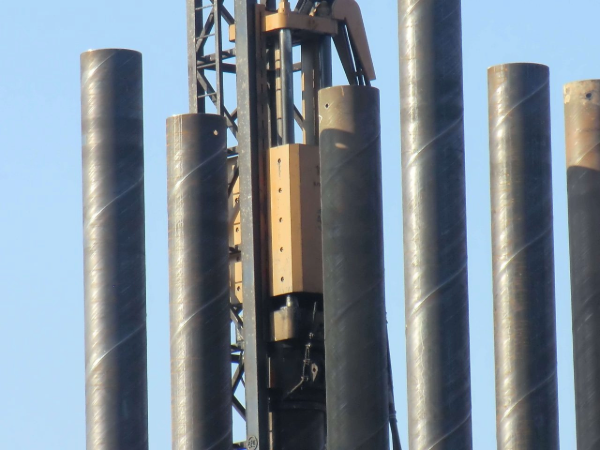
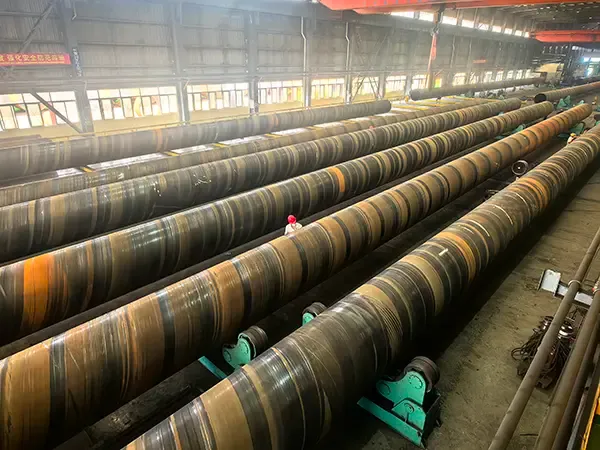
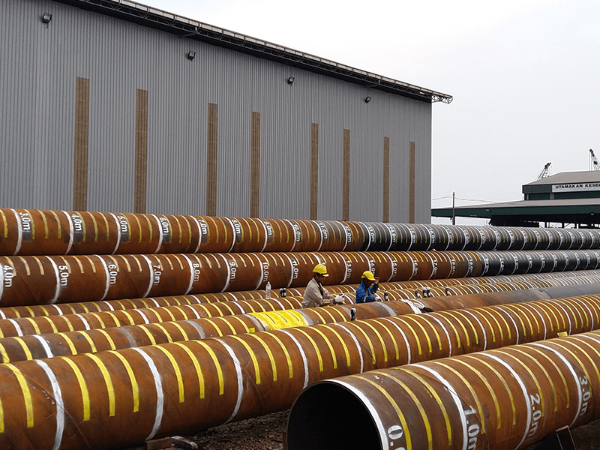
When foundation loads exceed soil bearing capacity at 30-50m depth, driven steel pipe piles transfer structural loads through skin friction and end-bearing to competent strata. OD 219-1626mm (8.625-64"), WT 6-70mm (0.250-2.75"), ASTM A252 Gr.1-3 / API 5L Gr.B-X70. Open-ended (unplugged) or closed-ended (plugged) configurations. Unlike precast concrete piles, steel pipe piles offer higher driving resistance, full-length splice weldability, and PDA-monitored capacity verification per ASTM D4945. AWS D1.1 certified welders. Supplied to offshore platforms, bridge piers, and marine terminals for COOEC, Samsung Heavy Industries, and Hyundai Engineering & Construction from our LSAW pipe factory in Cangzhou, Hebei, China.
|
Scope |
Steel pipe piling for permanent, structural load-carrying member or as a shell to form cast-in-place concrete piles. |
|
Specification |
ASTM A252, Grades 2 and 3/modified to 50 ksi min. yield |
|
Size (OD) |
8.625, 10.750 and 12.750 |
|
Gauge/Wall Thickness |
0.250, 0.313, 0.375 and 0.500 (nominal) |
|
Strength/Elongation Properties |
Yield: 50 ksi min., 60 ksi min., 75 ksi min., 80 ksi min. Aim to. Tensile: 66 ksi min. Elongation: 20% min. |
|
Straightness Tolerance |
1/8” x length (in feet), divided by five |
Piling Steel Pipe Specification
|
Scope |
Steel pipe piling for permanent, structural load-carrying member or as a shell to form cast-in-place concrete piles. |
|
Specification |
ASTM A252, Grades 2 and 3/modified to 50 ksi min. yield |
|
Size (OD) |
8.625, 10.750 and 12.750 |
|
Gauge/Wall Thickness |
0.250, 0.313, 0.375 and 0.500 (nominal) |
|
Strength/Elongation Properties |
Yield: 50 ksi min., 60 ksi min., 75 ksi min., 80 ksi min. Aim to. Tensile: 66 ksi min. Elongation: 20% min. |
|
Straightness Tolerance |
1/8” x length (in feet), divided by five |
|
Weight Tolerance |
Weight must not vary more than 15% over or 5% under. Piling weight controlled by utilizing minimum-gauge coil stock. Searing does not weigh each individual length of pipe. |
|
Chemical Composition |
Carbon: 0.23 max. Manganese: 1.35 max. Meets ASTM A252 |
|
Carbon Equivalent (CE) |
0.45 max (per AWS D1.1) |
|
Weldability |
AWD D1.1 base metal Can be welded with AWS prequalified welding procedures |
|
Testing |
ASTM A370: In-house flattening and cone test per heat |
|
Material Test Reports |
Material test reports are furnished for each length of pipe. Steel mill coil certifications/gauge certifications available upon request. |
|
Marking/ID Stamp |
Ink stenciling on one side of the OD, ID stamping when requested |
|
STRENGTH LEVELS |
GRADE 2 |
GRADE 3 |
|
Yield Strength |
35,000 psi min. |
45,000 psi min. |
|
Tensile Strength |
60,000 psi min. |
66,000 psi min. |
|
Elongation % in 2” Min. |
25 |
20 |
|
Meets AWS D1.1 Base Metal Welding requirements |
Yes |
Yes |
Advantages of Pipe Piles
As opposed to other options for deep foundations, pipe piles offer several advantages.
1. They lower costs because they are capable of being tailored to meet specific load bearing requirements.
2. They are simple to drive and install, and they’re easy to inspect and test before use.
3. They are sturdy and unlikely to crack or otherwise get damaged while they are being driven into the ground.
4. Additionally, pipe piles can be added to bolster foundation support after construction and during various phases of construction.
Application of Steel Pipe Piles
Pipe piles can be used for the creation of the following:
• Building foundations
• Bridge foundations
• Highway foundations
• Marine structure foundations
• Dock foundations
• Offshore construction foundations
• Railway foundations
• Oilfield construction foundations
• Communication tower foundations
• Column foundations
Types of Piling Steel Pipes
Based on the different soil environments and requirements, Pipe piling could be divided in open end pile (Unplugged pipe pile) and close end pile pipe(Plugged pipe pile).
Process
As soon as we receive your pipe pile designs, our fabrication division will begin creating your pipe piling. Fabrication is usually carried out in these steps:
1. Cut out and etch steel plate with CNC plasma cutters.
2. Bevel the plate ends (if required) to ensure quality welding.
3. Roll the plate into cylinders.
4. Weld the longitudinal seam of the cylinder.
5. Connect cylinders by welding the circumferential seam using our sophisticated submerged arc process.
6. Forward the pipe pile to our testing division, where the completed pipe piling must pass rigorous inspection before shipment to the job site.
7. If project specifies, the steel is blasted and coated to increase longevity.
Tests
Our Testing Capabilities Include:
• Visual inspection and step by step monitoring of all processes to ensure the best possible quality
• Radiographic Testing (RT)
• Ultrasonic Testing (UT)
• Dye Penetrant Testing (PT)
• Magnetic Particle Testing (MT)
• Heat treating and stress relieving
• Hardness Testing
• Impact Testing
• Positive Material Identification (PMI)
• Leak Testing
• Hydrostatic Testing, up to 2,500 psig
• Environmental monitoring and reporting
• Soluble Salt Testing
• Full blast and lining profile measuring
• Dry film thickness testing
• Adhesion Testing
• Lining continuity (holiday) testing

Piling Steel Pipe Weight and Dimension Tolerances
Pipe pile weights per units (Feet, meter or lengths)
Tolerance allowed: A252 pipe pile weight shall be in +15% or -5% of theoretic weight. OD tolerances at +/-1%, wall thickness +/- 12%.
Lengths: As specified SRL, DRL, or fixed length 20 ft or 40 ft and customized.
Permissible Variations for A252 Piling Steel Pipe
Wall thickness: Not more than 12.5% under the nominal wall thickness specified.
Weights per foot: The weight of any individual length of pipe shall not vary more than 15% over or 5% under the weight specified. Each individual length shall be weighed separately.
Outside diameter: Shall not vary more than plus or minus 1% from the diameter specified.
|
TOLERANCES |
ALL GRADES |
|
OD Size |
|
|
>1.9 - 2.5 incl. |
+/- 1% |
|
>2.5 - 3.5 incl. |
+/- 1% |
|
>3.5 - 5.5 incl. |
+/- 1% |
|
>5.5 |
+/- 1% |
|
Wall Thickness |
–12.5% |
|
Weight |
+15% / –5% |
|
Straightness (max. allowed) |
Not specified |
Chemical Requirements for A252 Steel Pipe
|
|
Phosphorus |
|
Seamless and ERW Welded |
Max% 0.050 |
|
Chemical Composition |
Carbon: 0.23 max. Manganese: 1.35 max. Meets ASTM A252 |
|||
|
CHEMISTRY LEVELS |
ALL GRADES |
|||
|
Carbon |
N/A |
|||
|
Manganese |
N/A |
|||
|
Phosphorus |
0.050 max. |
|||
|
Sulphur |
N/A |
|||
|
Silicon |
N/A |
|||
|
Grain Refining Elements |
N/A |
|||
Ultimate bearing capacity: Qu = Qs + Qt
Skin friction (Qs):
(1) Alpha method: Qs = α × Su × As
Where α = adhesion factor (0.5-1.0), Su = undrained shear strength, As = surface area
(2) Beta method: Qs = β × σ'v × As
Where β = friction coefficient (0.3-0.8), σ'v = effective vertical stress
Tip resistance (Qt):
(1) Cohesionless soil: Qt = Nq × σ'v × At
Where Nq = bearing factor (10-60), At = tip area
(2) Cohesive soil: Qt = Su × Nc × At
Where Nc = bearing factor (5-9)
Design approach: Site-specific soil investigation (CPT, SPT) required.
Open-ended piles develop internal soil plug during driving:
Plugging states:
(1) No plug — soil enters pipe, driven as open tube (low resistance)
(2) Partial plug — soil compresses inside, some capacity from internal friction
(3) Full plug — soil fully blocks pipe end, behaves like closed-ended
Plug resistance calculation:
Qplug = Qs_internal + Qtip_plug
Where internal friction depends on:
(1) Soil density — dense sand develops higher friction
(2) Impedance ratio — ID/OD affects plug formation
Driving considerations:
(1) Sand — plug forms quickly, high drivability
(2) Clay — plug may not form, remains open
Xenith Steel offers open-ended piles with driving shoes for project flexibility.
PDA (Pile Driving Analyzer) monitors real-time driving:
Measurements:
(1) Strain — force during driving
(2) Acceleration — velocity calculation
(3) Compression and tension stress — prevents damage
(4) Capacity — CAPWAP analysis for bearing capacity
Stress limits (per API 2A-WSD):
(1) Compression ≤ 0.9 × yield strength
(2) Tension ≤ 0.9 × yield strength (prevention of yield)
Driving criteria:
(1) Final set per blow — refusal criteria (e.g., 10mm/10 blows)
(2) Hammer energy — matches pile size and soil conditions
(3) Driving time — productivity indicator
Xenith Steel can arrange PDA monitoring for critical projects.
Negative skin friction (NSF) — downward force from consolidating soil:
Causes:
(1) Soft clay settlement — soil moves down relative to pile
(2) Peat layers — high compression
(3) Fill placement — recently placed surcharge
Calculation:
NSF = α × Su × As (for clay)
Where adhesion factor = 0.3-0.5 (reduced from positive friction)
Mitigation methods:
(1) Coating — bitumen wrap reduces adhesion to 0.1-0.2
(2) Larger diameter — reduces NSF/load ratio
(3) Pile cap elevation — allows settlement without NSF transfer
Design consideration: NSF can reduce allowable load by 30-50% in soft soils.
Pile splices must develop 100% pipe strength:
Splice types:
(1) Full-penetration groove weld — most common, develops 100%
(2) Partial-penetration groove — not recommended for tension
(3) Sleeve weld — full circumference required
Groove weld design:
(1) Full V or U groove — complete root penetration
(2) Back-gouging — remove root flaws for complete fusion
(3) Multi-pass welding — fill groove completely
Strength verification:
Tensile test of splice joint (full pipe vs spliced pipe)
Acceptance: ≥ 100% of pipe minimum yield
Xenith Steel welders hold AWS D1.1 certification.
Soil-specific driving considerations:
Sand and gravel:
(1) High resistance — may require impact hammers
(2) Low set-per-blow — dense granular structure
(3) No soil adhesion — pure skin friction
Clay:
(1) Variable resistance — depends on sensitivity
(2) Spudding — starting resistance control
(3) Adhesion — clay sticks to pipe surface
Rock:
(1) Predrilling usually required
(2) Rock shoes for tip protection
(3) Limited penetration — end-bearing design
driving recommendations:
(1) Wave equation analysis (GRLWEAP) — optimize hammer selection
(2) Subgrade investigation — geology-specific approach
Xenith Steel provides pile driving consultation.