
|
|
|
Type |
Momentof inertia |
Sectionmodulus |
Unit mass |
Maximumlength |
Grade |
|||||||||
|
|
|
|
|
|
|
|
JIS A 5523 |
JIS A 5528 |
KS F4604 |
EN10248 |
ASTM |
|||||
|
|
|
|
I (cm4/m) |
Z(cm³/m) |
W (kg/m2) |
L (m) |
SYW295 |
SYW390 |
SYW430 |
SY295 |
SY390 |
SY300 |
S355GP |
S430GP |
A572 Gr.50 |
A992 Gr.50 |
|
Hat-type sheet piles |
Hat w= 900 mm |
NS-SP-10H |
10,500 |
902 |
96 |
30*2 |
✓ |
✓ |
✓ *4 |
– |
– |
– |
–*2 |
–*4 |
✓ *2 |
– |
|
|
|
NS-SP-25H |
24,400 |
1,610 |
126 |
30*2 |
✓ |
✓ *1 |
✓ *1 |
– |
– |
– |
–*2 |
–*4 |
✓ *2 |
– |
|
|
|
NS-SP-45H |
45,000 |
2,450 |
163 |
24*1*2 |
✓ |
✓ |
✓ *1 |
– |
– |
– |
–*2 |
–*2 |
–*4 |
– |
|
|
|
NS-SP-50H |
51,100 |
2,760 |
186 |
23.5*1*2 |
✓ *1 |
✓ *1 |
✓ *1 |
– |
– |
– |
–*2 |
–*2 |
–*4 |
– |
|
|
Hat+H w= 900 mm |
NS-SP-10H+HY NS-SP-25H+HY |
87,800 to 1,316,000 |
2,320 to 19,970 |
169 to 514 |
30*2 |
Please refer to "NS-SP-10H"and "NS-SP-25H". H-shapes is also available JIS, ASTM and BS.*2 |
|||||||||
|
|
Hat + (Hat+H)w=900 mm |
NS-SP-10H+HY |
49,100 to 273,000 |
1,290 to 4,940 |
132 to 210 |
30*2 |
|
|||||||||
|
Straightweb-type sheet piles |
Straight webw= 500 mm |
NS-SP-FL |
396 |
89 |
123 |
38*2 |
✓ |
✓ |
–*4 |
✓ |
✓ |
– |
✓ *2*3 |
–*4 |
✓ *2 |
✓ |
|
|
|
NS-SP-FXL |
570 |
121 |
154 |
38*2 |
✓ |
✓ |
✓ |
✓ |
✓ |
– |
✓ *2 |
✓ *2 |
✓ *2 |
✓ |
|
U-type sheet piles |
U-type w= 600 mm |
NS-SP-Ⅱw |
13,000 |
1,000 |
103 |
30*2 |
✓ |
✓ |
–*4 |
✓ |
✓ |
✓ |
✓ *2 |
–*4 |
✓ *2 |
– |
|
|
|
NS-SP-Ⅲw |
32,400 |
1,800 |
136 |
30*2 |
✓ |
✓ |
–*4 |
✓ |
✓ |
✓ |
✓ *2 |
–*4 |
✓ *2 |
– |
|
|
|
NS-SP-Ⅳw |
56,700 |
2,700 |
177 |
30*2 |
✓ |
✓ |
– |
✓ |
✓ |
✓ |
✓ *2 |
–*4 |
✓ *2 |
– |
|
|
w= 500 mm |
NS-SP-VL |
63,000 |
3,150 |
210 |
30*2 |
✓ |
✓ |
– |
✓ |
✓ |
✓ |
✓ *2 |
–*4 |
✓ *2 |
– |
|
|
|
NS-SP-VIL |
86,000 |
3,820 |
240 |
30*2 |
✓ |
✓ |
– |
✓ |
✓ |
✓ |
✓ *2 |
–*4 |
✓ *2 |
– |
|
|
w= 400 mm |
NS-SP-Ⅱ |
8,740 |
874 |
120 |
25*2 |
✓ |
–*4 |
✓ *4 |
✓ |
–*4 |
– |
–*4 |
–*4 |
– |
– |
|
|
|
NS-SP-Ⅲ |
16,800 |
1,340 |
150 |
30*2 |
✓ |
✓ |
✓ *1 |
✓ |
✓ |
✓ |
✓ *1*2 |
✓ *1*2 |
✓ *2 |
– |
|
|
|
NS-SP-ⅢA |
22,800 |
1,520 |
146 |
30*2 |
– |
✓ |
– |
✓ |
– |
✓ |
– |
– |
– |
– |
|
|
|
NS-SP-Ⅳ |
38,600 |
2,270 |
190 |
30*2 |
✓ |
✓ |
✓ |
✓ |
✓ |
✓ |
✓ *1*2 |
✓ *1*2 |
✓ *2 |
– |
|
NS-SP-J |
NS-SP-J w= 600 mm |
NS-SP-J |
12,090 |
1,175 |
145 |
30*2 |
✓ |
✓ |
– |
✓ |
✓ |
✓ |
✓ *4 |
–*4 |
✓ *2 |
– |
*1) Please contact us detail in advance to order.
*2) Tolerance of dimension based on JIS standard (refer to page 11)
*3) Mechanical property of elongation based on JIS standard (refer to page 11)
*4) Please contact us availability.
Applications of Steel Sheet Pile:
Bulkheads – from small retaining walls for private marinas to large dry docks, ports, and other infrastructure projects
Cofferdams – temporary, in water or on land, to permit excavation for and construction of permanent works
Cut-off Walls – in connection with earth or concrete dams or dikes to retard seepage
Environmental Barrier Walls – for contaminant containment purposes
Cofferdams–“temporary, in water or on land, to permit excavation for and construction of permanent works
Cut-off Walls–“in connection with earth or concrete dams or dikes to retard seepage
Environmental Barrier Walls–“for contaminant containment purposes
Temporary and Permanent Retaining Walls
Seawalls, Flood Walls, Dikes, Jetties, Groins
Navigation Lock Walls and other large navigation structures
Mooring and Turning Cells, Dolphins
Barge Docks–“consisting of individual cellular structures
Bridge Protection Cells–“to protect bridge piers from shipping collisions.
Bridge Abutments
Temporary or Permanent Below Grade Shoring–“for basements and parking structures
Artificial Islands
Types of Steel Sheet Pile:
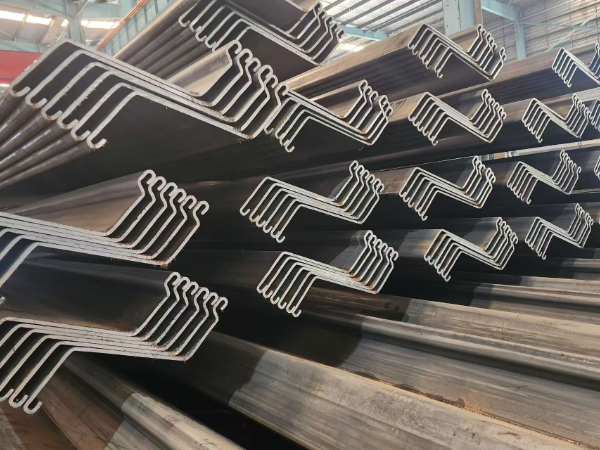
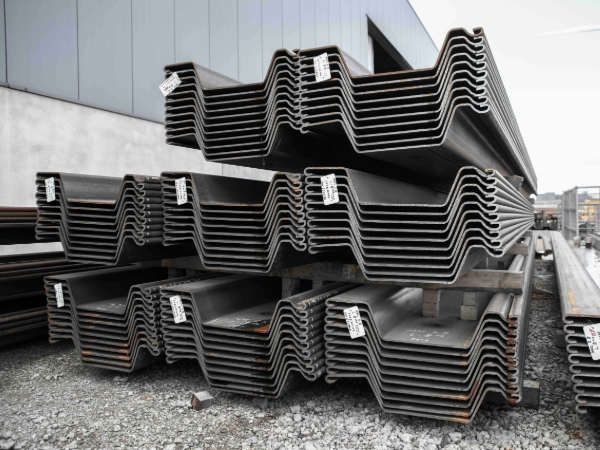
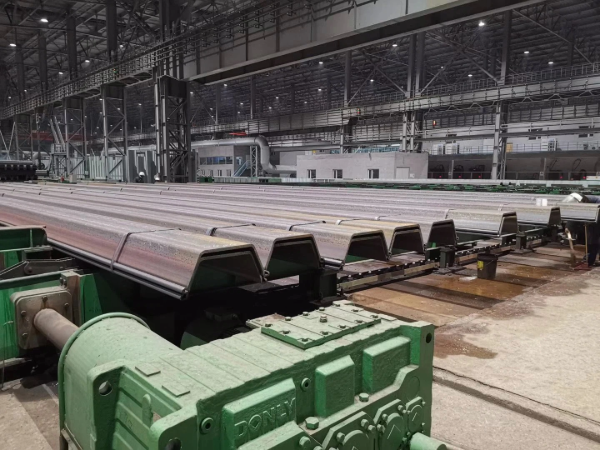
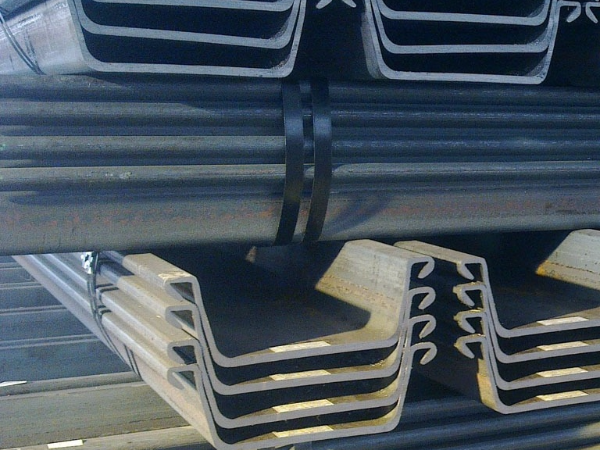
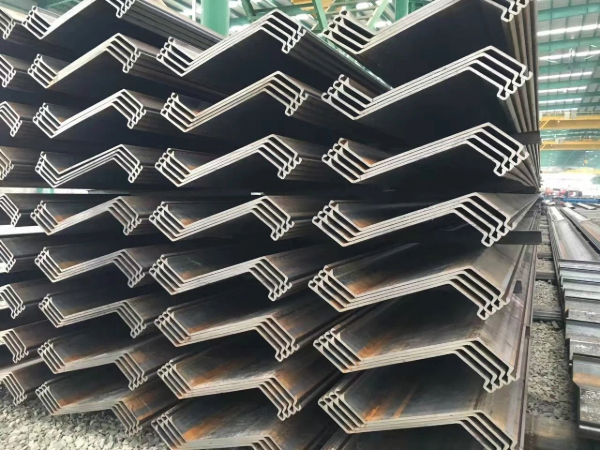
Steel sheet piling is manufactured in three basic configurations: "Z", "U" and "straight" (flat). Historically, such shapes have been hot-rolled products produced at structural mills. Like other shapes such as beams or channels, the steel is heated in a furnace and then passes through a series of rolls to form the final shape and the interlock, which allows the sheet piles to be threaded together. Some manufacturer's use a cold-forming process in which steel coil is rolled at room temperature into the final sheet pile shape. Cold formed sheet piles have hook and grip interlocks.
Grades of Steel Sheet Piling:
Sheet piling is specified by reference to the ASTM standard. The basic grade is ASTM A572 Gr 50, with many manufacturers producing ASTM A572 Gr 60 as the new standard.
Additional grades of steel for piling have been developed for possible use where corrosion is a consideration. ASTM A690 and A588 are 50 ksi (345 MPa) yield steels of a formulation which has demonstrated increased life. ASTM A690 has been shown to reduce the corrosion rate in the splash zone by 2 to 3 times. A588, also known as weathering steel, is resistant to corrosion in the atmospheric zone.
There are other proprietary steel grades, such as AMLoCor®, which has been shown to reduce the corrosion rate in the permanent immersion zone by up to 5 times.
The steel sheet pile generally has the material inspection and the appearance inspection, in order to correct the steel sheet pile which is not required, so as to reduce the difficulty in piling process.
(1) appearance inspection: including surface defects,length, width, thickness, end to rectangle ratio, flatness and the shape of the lock mouth, etc.. Need attention:
A, have influence on the welding pieces into the steel sheet pile should be cut off; B, cut hole and section defect should be reinforced:
The actual section thickness should be measured if C and steel plate piles are seriously corroded. In principle, the
Quality inspection of all steel sheet piles should be carried out
(2) material test: the chemical composition and mechanical properties of steel sheet pile base material are comprehensively tested.Including the chemical composition analysis of steel, tensile and bending test of
Components,locking strength test and elongation test.At least one tensile and bending test is carried out for each specification of steel sheet pile: two steel specimens per 20-50t weight should be tested.
Hot rolled sheet piles are produced from steel blooms at temperatures exceeding 1000°C, resulting in uniform wall thickness across the entire cross-section. The Larssen interlock is continuously fusion-welded at the factory, ensuring superior watertightness with permeability rates below 1×10⁻⁵ cm/s under standard driving conditions.
Cold formed sheet piles are manufactured by progressive bending of hot-rolled coils at ambient temperature. Wall thickness varies from 5mm at the web center to 8mm at flange edges. Interlock integrity depends on cold work hardening; no welding is applied to the interlock seam.
Application selection: Permanent marine structures (harbor walls, seawalls, cofferdams), critical water-retaining structures, and projects requiring driving through hard strata mandate hot rolled sections. Temporary earth retention, cut-off walls for basement excavations, and short-term cofferdams with scheduled removal favor cold formed for economic reasons.
Section modulus selection follows Eurocode 3 or ASTM A328 design procedures. Calculate maximum design bending moment from soil pressure distribution (at-rest or active earth pressure coefficient depending on wall displacement). Divide allowable stress (typically 0.65×yield for temporary works, 0.50×yield for permanent) into design moment to obtain required section modulus.
U-shaped sections (PU, PU-R, AU series) provide symmetrical interlock geometry ideal for circular cofferdams and axisymmetric structures. Z-shaped sections (AZ, HZ-A, ZX series) offer higher section modulus per meter of wall width due to neutral axis separation, making them economical for cantilever and anchored walls.
Interlock selection: Larssen (socket) interlock provides positive water seal but limits angular deflection to 3° per pile. Ball-and-socket interlock permits 5-7° deflection, essential for curved walls with radii below 30m. Combined interlock (free-clutching) allows rapid driving without initial positioning accuracy—preferred for temporary works where speed dominates.
Base steel: S270GP to S460GP per EN 10248 (yield strength 270-460 MPa). ASTM A328 governs US market with minimum yield 45 ksi (310 MPa). Corrosion rate in atmospheric exposure averages 0.1mm/year in temperate climates; marine splash zones experience 0.3-0.5mm/year.
Protective systems: Shop-applied bituminous coating (600μm DFT) for buried sections. Epoxy coating systems (400-800μm DFT) for splash zone immersion. Hot-dip galvanizing (85μm minimum) for atmospheric service. Concrete encasement over critical zones provides 50+ year service life.
For permanent marine installations, specify cathodic protection compatibility. High-strength low-alloy (HSLA) grades like ASTM A572 Grade 50 offer 30% thickness reduction for equivalent corrosion allowance, offsetting material premium with fabrication and handling savings.
Impact hammering (5-15 ton ram): Applicable for stiff clays, dense sands, and stratified soils with gravel layers. Energy transfer efficiency 60-80%; requires follower cap to protect pile head. Maximum practical depth 40m in cohesive soils. Pre-augering recommended when N-values exceed 50 blows/300mm.
Vibratory driving (30-150kN eccentric moment): Effective in loose to medium-dense granular soils, non-cohesive fills. Near-zero effective stress zones achieve highest installation speed (0.5-2m/min). Cohesive soils with undrained shear strength exceeding 80kPa cause diminishing returns. Noise and vibration levels require monitoring within 30m of sensitive infrastructure.
Jetting assistance: 20-50mm water jet at 2-5 bar accelerates penetration through sandy strata. Prevents clogging of Larssen interlock in water-saturated conditions. Combined with vibratory driver reduces total driving time by 30-50% in favorable geology.
Per EN 12063 and ASTM D38, standard tolerances: verticality ±2% of exposed length for cantilever sections, ±1% for anchored walls. Horizontal alignment ±75mm from design centerline. Interlock cleanliness mandatory—compressed air cleaning of engaged seams before each pitch prevents grit infiltration and driving obstruction.
Interlock continuity verification: Leak-off test using air pressure (0.5 bar) injected between sealed pair of interlocks. Sustained pressure indicates intact sealing; pressure decay signals interlock damage requiring pile extraction and replacement.
EN 10204 Type 3.1 mill test certificates mandatory: heat chemistry (C, Mn, Si, P, S ≤ limits per grade), tensile testing (yield, UTS, elongation), bend test for plates under 16mm. Dimensional inspection per EN 10248-2: thickness -5%/+10%, width ±50mm, length +125mm/-0mm.
Third-party inspection agencies (SGS, Bureau Veritas, DNV, Lloyd's Register) available for witness inspection at mill and pre-shipment. Inspection scopes include: material verification, dimensional check, visual examination for surface defects, interlock geometry measurement using go/no-go gauges.
Special documentation: CE marking per EN 1090-1 for permanent works in EU. NACE MRO175/ISO 15156 compliance documentation for H₂S service in oil/gas applications. Corrosion data reports for marine environment exposure assessments.
| Item | ASTM A6 |
| Length | + 125 mm |
| -0 mm | |
| Mass tolerance | ±2.5% |
Please contact us in case above tolerances are applied.
JIS A 5523 : 2012 Weldable hot-rolled steel sheet piles
JIS A 5528 : 2012 Hot-rolled steel sheet piles
Chemical composition of the ladle analysis
|
Classification |
Grade |
Chemical composition(%) |
Ceq.(%) |
|||||
|
C |
Si |
Mn |
P |
S |
N |
Ceq. |
||
|
Weldable hot rolled steel sheet piles |
SYW295 |
0.18max. |
0.55max. |
1.50max. |
0.040max. |
0.040max. |
0.0060max. |
0.44max. 0.45max. |
|
SYW390 |
||||||||
|
Hot rolled steel sheet piles |
SY295 |
ー |
ー |
ー |
0.040max. |
0.040max. |
ー |
ー |
|
SY390 |
||||||||
Note: Ceq.=C+Mn/6+Si/24+Ni/40+Cr/5+Mo/4+V/14
Mechanical properties
|
Standard |
Classification symbol |
Yield point N/mm² |
Tensile strength N/mm² |
TestPiece |
Elongation % |
Charpy absorbed energy, J |
Type and direction of test piece |
|||
|
Testtemperature (℃) |
Standard size test specimen |
Sub-size test specimen |
||||||||
|
10×10mm |
10×7.5mm |
10×5mm |
||||||||
|
Weldable hot rolled steel sheet piles JIS A 5523 |
SYW295 |
295min. |
450min. |
No.1A |
18min. |
0 |
43min. |
32min. |
22min. |
V notch in rolling direction |
|
No.14B |
24min. |
|||||||||
|
SYW390 |
390min. |
490min. |
No.1A |
16min. |
||||||
|
No.14B |
20min. |
|||||||||
|
Hot rolled steel sheet piles JIS A 5528 |
SY295 |
295min. |
450min. |
No.1A |
18min. |
ー |
ー |
ー |
ー |
ー |
|
No.14B |
24min. |
|||||||||
|
SY390 |
390min. |
490min. |
No.1A |
16min. |
||||||
|
No.14B |
20min. |
|||||||||
Note: Chemical composition and mechanical properties conform to JIS A 5523-2012 or JIS A 5528-2012 .
N is shown by total in accordance with section 5. Note 2 of JIS A 5523-2012.
BS EN 10248-1 : 1996
Hot-rolled sheet piling of non-alloy steel Part 1. Technical delivery conditions
Chemical composition of the ladle analysis
|
Steel name |
Chemical composition % max1) |
|||||
|
C |
Mn |
Si |
P |
S |
N1) |
|
|
S355GP |
0.24 |
1.60 |
0.55 |
0.045 |
0.045 |
0.009 |
|
S430GP |
||||||
Mechanical properties
|
Steel name |
Minimum yield strength (N/mm²) |
Minimum tensile strength (N/mm²)1) |
Minimum elongation on a gauge length of L0 = 5.65 √S0 A% |
|
S355GP |
355 |
480 |
22 |
|
S430GP |
430 |
510 |
19 |
1) See the specific limitation in the standard.
* Please contact us in advance.
ASTM A572M / A572-12
High-strength low-alloy columbium-vanadium structural steel
Chemical composition of the ladle analysis
|
Grade |
Chemical composition % max |
||||
|
C |
Mn |
Si |
P |
S |
|
|
50 |
0.23 |
1.351) |
0.40 |
0.04 |
0.05 |
1) See the specific limitation in the standard.
Mechanical properties
|
Grade |
Minimum yield strength |
Minimum tensile strength |
Minimum elongation(%) |
|
50 |
50Ksi (345MPa) |
65Ksi (450MPa) |
In 8 in. (200 mm):18 In 2 in. (50 mm):21 |
* Please contact us in advance