Frequently Asked Questions
1. Why is a heat exchanger tube different from a boiler tube?
Different design basis:
Boiler tube: PRESSURE containment (internal steam pressure)
Heat exchanger: HEAT TRANSFER priority (temperature differential)
That changes everything:
(1) Wall thickness — exchanger tubes thinner for lower thermal resistance
(2) Surface finish — exchanger needs smooth for flow, boiler needs scale-resistant
(3) Thermal cycling — exchanger experiences more expansion/contraction cycles
(4) Finned tubes — exchanger uses fins to increase surface area
Using boiler tube in exchanger = wasted heat.
Using exchanger tube in boiler = rupture risk.
2. Why does 316L fail in seawater sometimes?
316L is NOT seawater-proof:
The pitting corrosion mechanism:
Seawater has ~3.5% chloride (19,000 ppm)
316L: Pitting Resistance Equivalent (PRE) = 24
Seawater threshold: PRE ≥ 40 required
Options for seawater:
316L + cathodic protection: OK for limited service
254 SMO (PRE=43): Better
Super duplex 2507 (PRE=43): Best
Titanium (Grade 2): Ultimate
Rule: For seawater, specify titanium or super duplex.
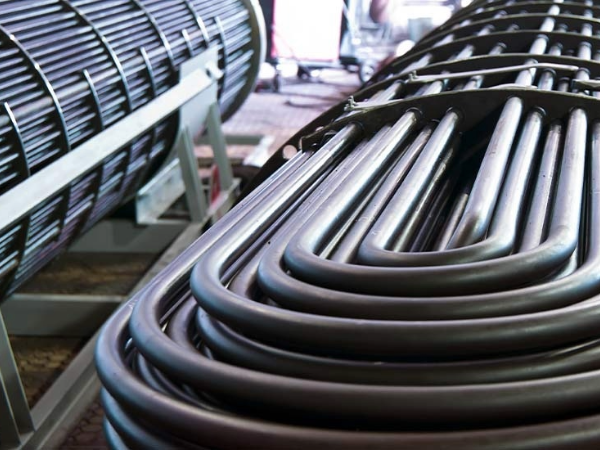
3. What causes U-bend tube cracks?
U-bend stress is highest at the extrados (outer bend):
Failure modes:
(1) Over-bending — tensile strain > 15% at extrados splits the tube
(2) Tube surface contamination — oil or carbide during bend causes cracks
(3) Tantalum precipitates — in TP347H, causes knife-line attack
Prevention:
Use proper bend radius: R ≥ 3× OD minimum
Bend with internal support (mandrel or w/coils)
Stress relieve after bend for critical service
Xenith Steel provides formed U-bends with inspection.
4. How does vibration cause heat exchanger failure?
Flow-induced vibration (FIV):
Natural frequency of tube vs vortex shedding frequency:
If they match → resonance → fatigue cracks
Tube natural frequency: f ∝ √(t/D²)
Vortex shedding: f = St × V / D
Where St = Strouhal number (~0.2)
Prevention:
Add tube supports to increase natural frequency
Use anti-vibration baffles
Limit operating velocity (especially at tube entrance)
5. Bright annealed vs pickled — which surface for my service?
The corrosion difference:
Bright annealed (BA):
(1) Free of oxide scale — maximum corrosion resistance
(2) Smooth surface — lower fouling tendency
(3) 10-15% higher heat transfer coefficient
Pickled & passivated:
(1) Chromium-depleted layer removed — better passivation
(2) Slightly rough surface — higher fouling initially
For fouling service: BA
For maximum corrosion resistance: Pickled
For high-purity chemicals: BA
6. What is the tube expanding ratio in tube-sheet joints?
Expanding seals by thinning the tube:
Expanding reduction: δ = (pre-OD - post-OD) / pre-OD
Typical expansion: 15-25%
15% = adequate for low pressure
20% = normal for most service
>25% = risk of over-stressing tube wall
Calculation:
Tube expands into tube-sheet hole
Contact pressure = E × δ × (D/t)
Where E = modulus, D = tube OD, t = wall thickness
Higher pressure = need higher expansion ratio.
7. What is the difference between 304L and 316L stainless steel for heat exchanger applications?
304L (Low Carbon ≤0.03%) vs 316L (Low Carbon ≤0.03%):
(1) Corrosion Resistance: 316L contains 2-3% molybdenum, superior chloride resistance. 316L recommended for coastal/marine environments, chloride-containing media. 304L adequate for fresh water, steam, most chemicals.
(2) Temperature: 316L max service temp 400°C (continuous), 304L 300°C. For higher temps, use 321H or 347H (stabilized, max 550°C).
(3) Heat Exchanger Selection: For seawater cooling, use 316L or super-duplex 2507. For high-temp steam/thermal oil, use 321H. For general process heat exchange, 304L is cost-effective.
(4) Cost: 316L typically 20-30% higher than 304L due to molybdenum content. Choose based on actual operating conditions.
We recommend PMI testing to verify material grade upon delivery. Carbon content affects intergranular corrosion resistance - both grades meet ASTM A262 practice E requirements.
8. What mechanical testing and quality control do you perform on heat exchanger tubes?
100% and sampling tests per ASTM A370, ASTM A1016:
(1) Hydrostatic Test - 100% tested. Test pressure = min(1.5x design pressure, max 17 MPa (2465 psi) for austenitic steel. Hold 10-30 seconds. Test report includes actual pressure, hold time.
(2) Eddy Current Test (ECT) - 100% tested. Per ASTM A1016, detects longitudinal defects, pores, pits. Sensitivity: 0.5mm diameter flat-bottom hole equivalent. Alternative: ultrasonic testing for wall >3mm.
(3) Tensile Test - Sample per batch. Yield strength: 304 ≥205 MPa, 316L ≥170 MPa. Tensile strength: 304 ≥515 MPa, 316L ≥485 MPa. Elongation ≥35% in 50mm.
(4) Flattening Test - Sample per batch. Flattens to 3x WT without cracks. Critical for weld seam integrity.
(5) Flaring Test - Sample per batch. Tube end expanded 15% without cracks per ASTM A214. Essential for U-tube forming.
(6) Hardness Test - Sample per batch. Max 90 HRB (304), 95 HRB (316L). Prevents work hardening issues.
Optional: Impact testing (CVN min 20J at 0°C), intergranular corrosion test (ASTM A262), grain size (ASTM E112), PMI (100% positive material identification).
9. What surface finishing options do you offer and how do they affect heat exchanger performance?
Surface finish affects heat transfer efficiency, fouling resistance, cleanability:
(1) Bright Annealed (BA) - Argon atmosphere, Ra ≤0.8μm. Best corrosion resistance, smoothest surface. Recommended for: high-purity chemicals, fouling service, sour gas. Surface: mirror-like, no oxidation.
(2) Pickled & Passivated - Standard commercial finish, Ra 1.0-2.0μm. Removes mill scale, free iron. Forms chromium oxide layer (10-15Å). Recommended for: general service, water/steam, moderate chemicals. Cost-effective.
(3) Mechanically Polished - Ra ≤0.4μm (super-polish). Improves heat transfer 3-5%. Reduces fouling. Used for: pharmaceutical, food, clean steam. Requires final passivation.
(4) Sanitary Finish - Ra ≤0.8μm, no pits/crevices. Required for: food, dairy, biotech. 3-A sanitary standard compliance available.
Selection: BA for worst fouling/sour service, pickled for general, polished for maximum heat transfer. Surface finish report with Ra measurement available upon request.
10. How do you ensure leak-free tube-to-tube sheet joints in heat exchanger assembly?
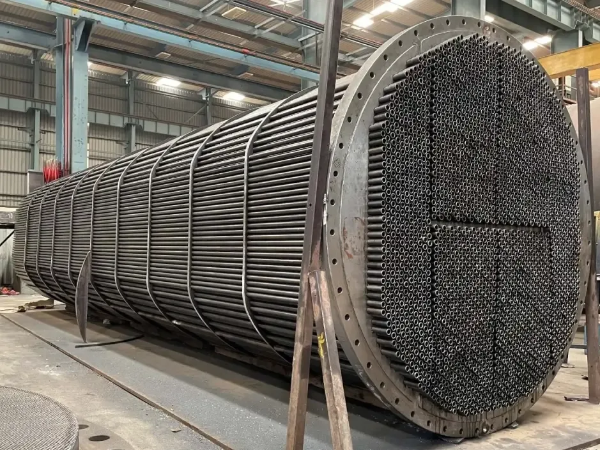
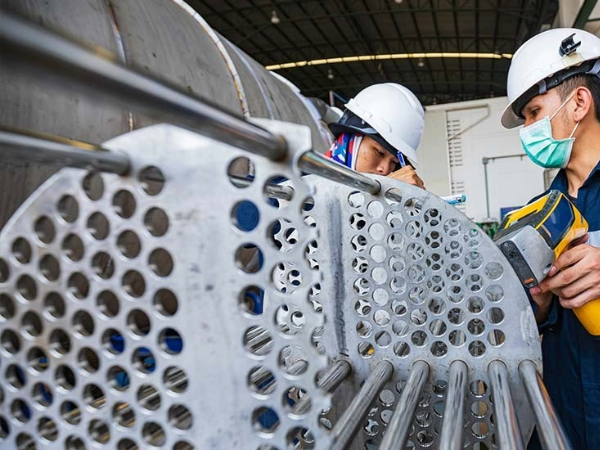
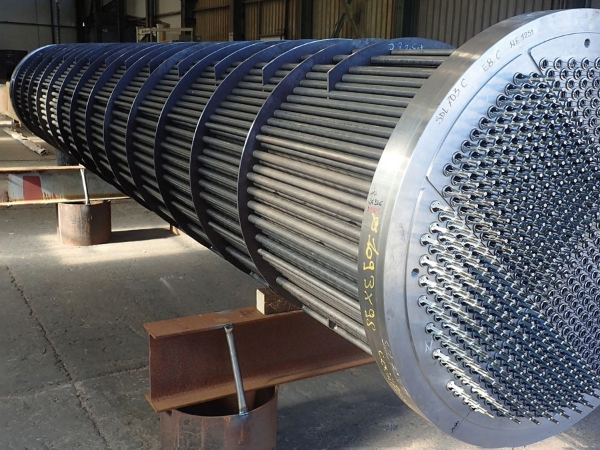
Tube-sheet joints critical for zero-leak performance. Our manufacturing process:
(1) Tube End Preparation: Chamfered per ASME Section IX, 30-37° angle, root face 0-1mm. Degreased, no burrs.
(2) Welding: GTAW (TIG) for root pass - argon shielding 99.999%, 15-20 L/min. Filler: ER308L (304), ER316L (316). Weld spec: AWS D1.6, AWS D17.1. Single-sided, full penetration.
(3) Post-Weld Treatment: 100% dye penetrant examination (DPE) on root pass per ASTM E165. No undercut, porosity, cracks allowed.
(4) Expansion: Roller expander or hydraulic expander. Expansion ratio 15-20% (1.15-1.25x original ID). Achieves tube-sheet metallurgical bond. Prevents crevice corrosion.
(5) Option: Welded + Expanded (Strengthened Joint). For high-pressure/thermal cycling. Expansion after welding restores tube wall.
(6) Testing: Optional helium leak test per ASTM E498, sensitivity 1×10⁻⁶ atm·cc/sec. All welders qualified to ASME Section IX.
11. What documentation and certifications do you provide for heat exchanger tube procurement?
Complete documentation package (per EN 10204 3.1):
(1) Mill Test Certificate (MTC) 3.1 - Chemical analysis (C, Mn, P, S, Si, Cr, Ni, Mo, Cu, N, Ti, Nb). Heat number full traceability to steel mill.
(2) Mechanical Test Reports - Yield, tensile, elongation. Actual values, not just "pass".
(3) 100% ECT Report - Each tube tested, no defects detected. Lists tube number, test result.
(4) Hydrostatic Test Certificate - Actual test pressure, hold time, no leakage.
(5) Dimensional Report - OD (±0.05mm), WT (±0.03mm), length (±1mm), ovality.
(6) Surface Finish Report - Ra measurement at 3 points per tube.
(7) Heat Treatment Record - Annealing temp, time, atmosphere.
Third-party inspection: SGS, BV, Lloyd's, TUV, DNV available at buyer cost. Additional certs: NACE MR0175 (sour service), API 5L/5CT (O&G), PED 2014/68/EU, AD 2000-Merkblatt W0. ISO 9001:2015 certified.