
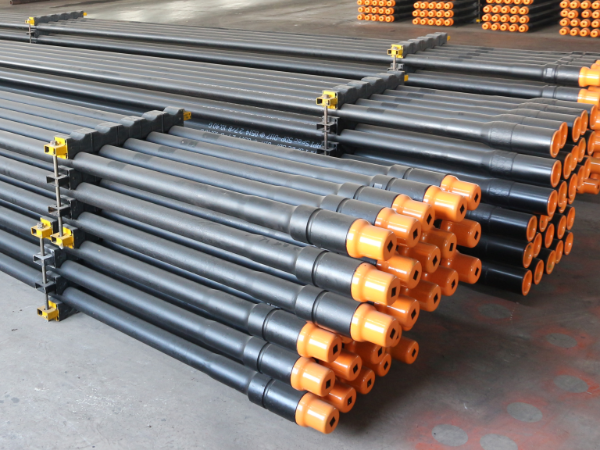
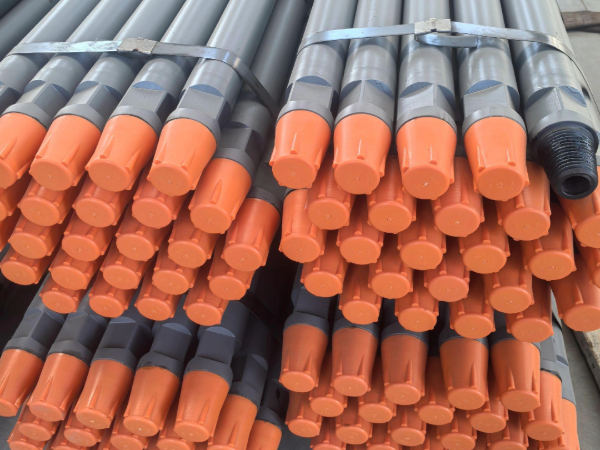
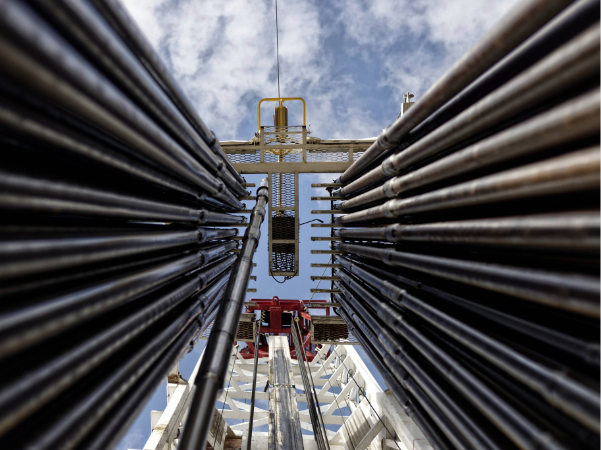
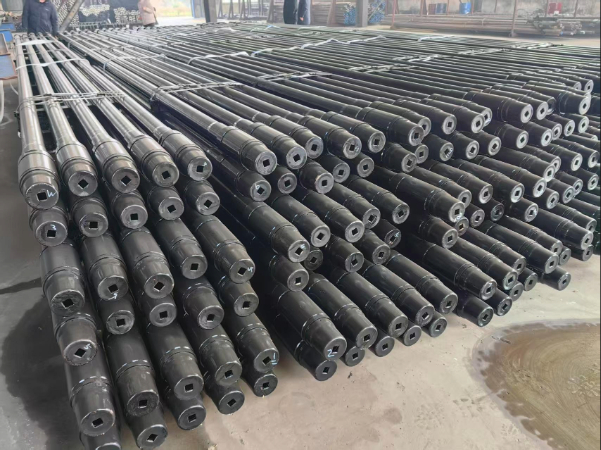
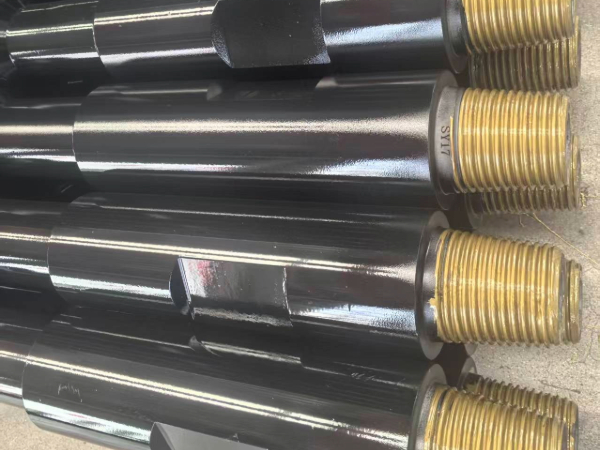
| Product: | Drill Pipe |
| Application: | Used for Mine, water well drilling, well drilling, coal and fore poling |
| Size: | OD: 2-3/8" to 7-5/8" |
| WT: 6.45-12.7mm | |
| LENGTH: R1, R2, R3 | |
| Pipe Standard: | API 5DP E75, X95, G105, S135 |
| Upset Style: | IU, EU, IEU |
| Connection: | NC26, NC31, NC38, NC40, NC46, NC50, 5 1/2FH.6 5/8FH. |
| Internal coating | TK34,TC2000, Arnco 100XT, 200XT, 300XT |
|
Product: |
Drill Pipe |
|
Application: |
Used for Mine, water well drilling, well drilling, coal and fore poling |
|
Size: |
OD: 2-3/8" to 7-5/8" |
|
WT: 6.45-12.7mm |
|
|
LENGTH: R1, R2, R3 |
|
|
Pipe Standard: |
API 5D,API 5DP E75, X95, G105, S135 |
|
Upset Style: |
IU, EU, IEU |
|
Connection: |
NC26, NC31, NC38, NC40, NC46, NC50, 5 1/2FH.6 5/8FH. |
|
Internal coating |
TK34,TC2000, Arnco 100XT, 200XT, 300XT |
Drill collars are a component of the drill string that makes up part of the BHA. They are thicker-walled, heavier, and more rigid than drill pipes and are primarily used to weigh down the drill bit while dampening vibration and impact forces.
Proprietary grades often exceed the specifications set forth by API SPEC 5DP. Their enhanced performance properties are developed for sour service, critical service, and other user-defined requirements.
Sour service grades resist sulphide stress corrosion (SSC). SSC can occur when hydrogen sulfide is present. Ingress of hydrogen coupled with higher stresses, low temperatures, low pH, and high chloride content decreases the ductility of steel grades leaving them susceptible to crack propagation and failure.
Critical service grades resist corrosion when sweet gas or high concentrations of carbon dioxide are present. They are a cost effective alternative that is used in water injection applications.
Drill pipe is manufactured according to standard specifications and is offered in nominal sizes. The two most important dimensional specifications are length and diameter.
The drill string is made up of several sections of drill pipe. The term "stand" refers to two or three sections of drill pipe that are fed into the well bore to complete 60 to 90 feet of drilling. Each segment of pipe, referred to as a "single", is classified by API into three distinct length ranges; R1, R2, and R3.
Range 1 (R1) is shortest in length, more common for sizing production tubing or casing, and ranges from 18 to 22 ft.
Range 2 (R2) is considered the standard length for drill pipe and ranges from 27 to 31 ft.
Range 3 (R3) is common in casing and also deployed in deep water drilling applications. The increased length decreases the number of tool joints in each stand of drill pipe. The fall back being that the load exerted on each tool joint is greater increasing wear and reducing the expected life of the drill pipe. R3 ranges from 38 to 45 ft.
The upset (thread-end finish) refers to the wall of the tool joint at the threaded connection. Drill pipe is offered with an internal upset (IU), an external upset (EU), or an internal-external upset (IEU).
IU - In an internal upset increased thickness along the inside walls compensate for the metal removed in threading with a uniform, straight outside wall.
EU - In an external upset the increased thickness along the outside diameter of the tubing compensates for the metal removed in threading with a straight bore.
IEU - In an internal-external upset thickness is increased along both the inside and outside walls of the pipe to compensate for the metal removed in threading.
Tool joints incorporate threaded connections. They include standard API threads as well as proprietary threads. Each type of threaded connection is specified by threads per inch (TPI) and it's taper. Common API tool joints include regular (REG), full-hole (FH), and internal-flush (IF).
Drill pipe manufacturing process includes steelmaking, continuous casting, hot rolling, upsetting, heat treatment, and quality inspection.
Drill pipes are bundled with steel strips, wrapped with waterproof plastic bags, and protected with thread caps. Loading into containers or bulk vessels.
|
API Drill Pipe Grade |
Minimum Yield Strength (psi) |
Minimum Tensile Strength (psi) |
|
E-75 |
75,000 |
100,000 |
|
X-95 |
95,000 |
105,000 |
|
G-105 |
105,000 |
115,000 |
|
S-135 |
135,000 |
145,000 |
|
Size designation |
Calculated weight |
Tool joint designation |
Calculated weight |
grade |
Wall thickness |
Upset ends |
||
|
in |
1b/ft |
Kg/m |
in |
mm |
||||
|
2 3/8 |
6.65 |
NC26 |
6.26 |
9.32 |
E.X.G.S |
0.28 |
7.11 |
EU |
|
2 7/8 |
10.4 |
NC31 |
9.72 |
14.48 |
E.X.G.S |
0.362 |
9.19 |
EU |
|
3 1/2 |
13.3 |
NC38 |
12.31 |
18.34 |
E.X.G.S |
0.368 |
9.35 |
EU |
|
3 1/2 |
15.5 |
NC38,NC40 |
14.63 |
21.79 |
E.X.G.S |
0.449 |
11.4 |
EU |
|
4 |
14 |
NC40,NC46 |
12.93 |
19.26 |
E.X.G.S |
0.33 |
8.38 |
IU,EU |
|
4 1/2 |
16.6 |
NC46,NC50 |
14.98 |
22.31 |
E.X.G.S |
0.337 |
8.56 |
EU,IEU |
|
4 1/2 |
20 |
NC46,NC50 |
18.69 |
27.84 |
E.X.G.S |
0.43 |
10.92 |
EU,IEU |
|
5 |
19.5 |
NC50,NC52 |
17.93 |
26.71 |
E.X.G.S |
0.362 |
9.19 |
IEU |
|
5 |
25.6 |
NC50,5 1/2FH |
24.03 |
35.79 |
E.X.G.S |
0.5 |
12.7 |
IEU |
|
5 1/2 |
21.9 |
5 1/2FH |
19.81 |
29.51 |
E.X.G.S |
0.361 |
9.17 |
IEU |
|
5 1/2 |
24.7 |
5 1/2FH |
22.54 |
33.57 |
E.X.G.S |
0.415 |
10.54 |
IEU |
|
6 5/8 |
25.2 |
6 5/8FH |
22.19 |
33 |
E.X.G.S |
0.33 |
8.387 |
IEU |
|
6 5/8 |
27.7 |
6 5/8FH |
24.21 |
41 |
E.X.G.S |
0.362 |
9.19 |
IEU |
Chemical Composition(%)
|
Grade |
Chemical composition |
|
|
P |
S |
|
|
E75 |
<0.015 |
<0.003 |
|
X95 |
<0.015 |
<0.003 |
|
G105 |
<0.015 |
<0.003 |
|
S135 |
<0.015 |
<0.003 |
|
Tool joint |
<0.015 |
<0.003 |
Mechanical Properties
|
Pipe body |
Grade |
Yield strength |
Tensile strength |
Elongation |
Hardness |
Full size charpy impact test(J) |
||||||
|
min |
max |
min |
min |
|||||||||
|
Psi |
MPa |
Psi |
MPa |
Psi |
MPa |
HBW |
HRC |
Average |
Single |
|||
|
E75 |
75000 |
517 |
105000 |
724 |
100000 |
689 |
625000A0.2/U0.9 |
- |
- |
80 |
65 |
|
|
X95 |
95000 |
655 |
125000 |
862 |
105000 |
724 |
- |
- |
80 |
65 |
||
|
G105 |
105000 |
724 |
135000 |
931 |
115000 |
793 |
- |
- |
80 |
65 |
||
|
S135 |
135000 |
931 |
165000 |
1138 |
145000 |
1000 |
- |
- |
80 |
65 |
||
|
Weld zone |
Tool joint |
120000 |
827.4 |
- |
- |
140000 |
965.3 |
=13% |
=285 |
- |
80 |
65 |
|
E75 |
75000 |
517 |
- |
- |
100000 |
689 |
- |
?37 |
40 |
27 |
||
|
X95 |
88000 |
609 |
- |
- |
103000 |
712 |
- |
?37 |
40 |
27 |
||
|
G105 |
95000 |
655 |
- |
- |
105000 |
724 |
- |
?37 |
40 |
27 |
||
|
S135 |
105000 |
724 |
- |
- |
115000 |
|
|
?37 |
40 |
27 |
||
Drill pipe grades indicate minimum yield strength:
E75 = 75,000 psi (most common for standard drilling)
X95 = 95,000 psi (for medium-depth wells)
G105 = 105,000 psi (for deep wells)
S135 = 135,000 psi (for ultra-deep and horizontal drilling)
Higher grades provide better resistance to tensile stress but are more expensive.
Tool joints connect drill pipe sections:
(1) NC (National Thread) - API standard threads (NC31 to NC56)
(2) REG (Regular Thread) - API standard for larger sizes (4 1/2 to 6 5/8 REG)
(3) IF (Internal Flush) - premium connection with better torque capacity
Tool joint size must match the drill string design and drilling rig capacity.
Every drill pipe undergoes:
(1) 100% visual inspection of tool joints and pipe body
(2) Dimensional inspection (OD, wall thickness, thread dimensions)
(3) Magnetic particle inspection (MPI) for crack detection
(4) Ultrasonic testing for wall thickness and defects
(5) Thread inspection with gauges
(6) Pull testing for tool joint integrity
Full MTC provided with each shipment.
HWDP (Heavy Weight Drill Pipe) has thicker walls than standard drill pipe (typically 1-1.5 inch wall) to add weight and stiffness to the drill string.
Used in:
(1) Directional drilling to provide weight on bit
(2) Deep wells where drill pipe alone cannot provide required weight
(3) Horizontal drilling to push the bit through horizontal sections
HWDP has tool joints identical to drill pipe for compatibility.
Regular inspection includes:
(1) Visual inspection for wear, damage, corrosion
(2) Wall thickness measurement via ultrasonic
(3) Thread inspection and gauge run
(4) Magnetic particle inspection of tool joints
(5) Torque verification
We offer drill pipe with full inspection records. For used drill pipe, we can provide re-certification services after thorough inspection.
Yes, we supply drill pipe with:
(1) Standard API tool joints (NC, REG) for general drilling
(2) Premium tool joints (e.g., XT, DS, premium connections) for high-torque applications
(3) Various thread types including left-hand for drill collars
We also offer drill pipe in various pin/box configurations to match your BHA requirements.